Colombia · 10 August 2026Magnitude 7.4 · 07:34 in the morningThe real wave of this earthquake · recorded by the Colombian Geological Survey


HIKIRed Cross Education Institute of Valle del Cauca

00shaking

seconds of shaking

90 seconds in total

On 10 August 2026, the ground under western Colombia moved for 90 seconds.This is how long that is

Magnitude 7.4, 68 miles down, at 7:34 in the morning.USGS event us6000tjl2

26,600,000 people in Colombia felt it.331 dead · 146,188 families affected · UNGRD, 25 August 2026

Then it stopped.
This is what stayed.

Waking at three in the morning. Every night.83% of survivors report trouble sleeping

A truck goes by and the body files it as the same sound.Startle response, months afterward

Tired from the moment you wake up.74% report fatigue with no physical cause

The stomach that hurts and the headache no doctor explains.63% and 58%

Not going to the market alone anymore. Not really deciding to.Avoidance, the symptom nobody reports

“I didn’t lose anything. Why am I like this?”The guilt of the one who came out fine

Five years on, a third of them still cannot sleep.35% · 8,966 survivors, Kumamoto

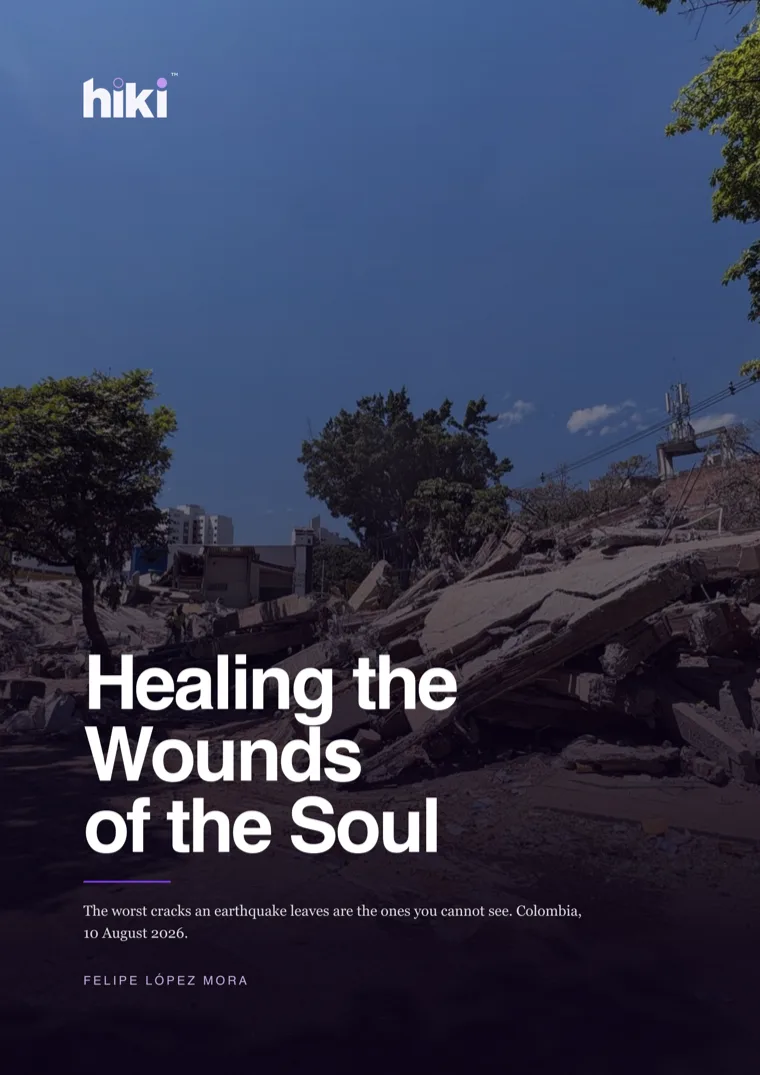
The worst cracks are the ones you can’t see.
Those are the ones that break people.

It stopped after 90 seconds. For 26 million people it hasn’t.

You can pay for someone’s place in a mental health class. One book costs USD 12.99 and pays for one hour of class. Eighty books put someone through the whole diploma, free.

Taught by Xiruela with the Colombian Red Cross

Taking you to the page

Stay the 90 seconds. It is how long they had, and they did not get to skip it.

HIKI Red Cross Education Institute of Valle del Cauca
Buy the book, open a seat
xiruelaCentro de Educación Continua
HIKI Red Cross Education Institute of Valle del Cauca

The worst cracks are the ones you can’t see. Those are the ones that break people.

A wall can be inspected and repaired. What an earthquake breaks inside a person cannot, and 26 million Colombians are carrying it right now.

Buy the book, open a seat

USD 12.99 buys the book.
One book pays one hour of training,
free for whoever takes it.

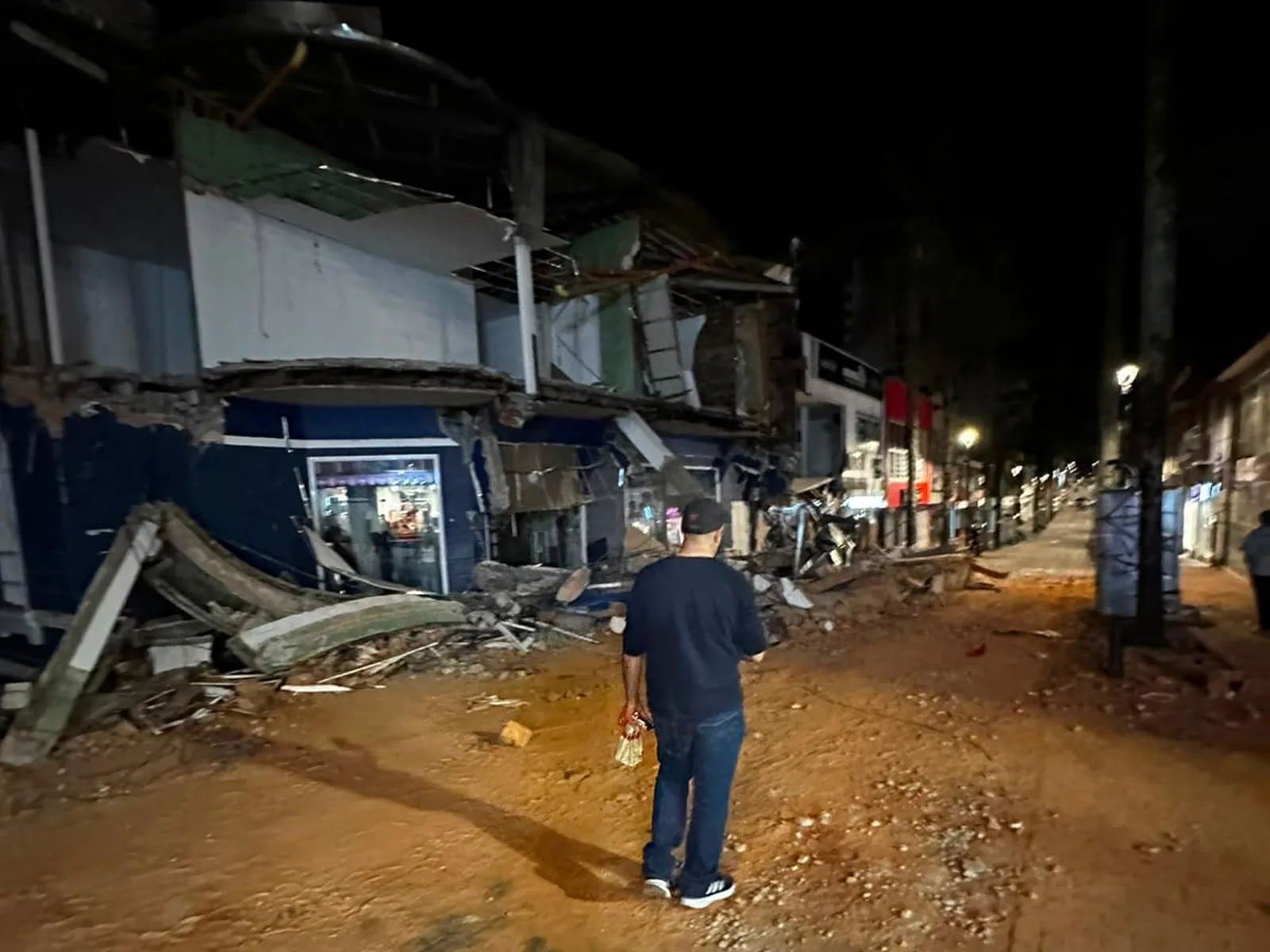
Reserva de Meléndez, Comuna 18, Cali · 200 homes evacuated · World Central Kitchen, CC BY 4.0

The morning of 10 August 2026

Life changed for the people of Colombia, and most of what changed does not show in a photograph.

Emergency reports count what can be measured from the street. Here is what they found, how many people felt the ground move under them, and the part that no damage report has ever been able to hold.

What fell

National Disaster Risk Management Unit, 25 August 2026

331

people killed

4,595

people injured

257

still missing

146,188

families affected

31,445

homes destroyed outright

163,884

homes damaged

3,423

schools damaged

334

health centers damaged

476

municipalities, in 15 departments

$9.57 bn

to rebuild, in dollars

The people the ground moved under

USGS us6000tjl2, population exposure

26,600,000

One Colombian in two felt the floor move under their feet that morning. They were in a kitchen, on a bus, in a classroom, and for ninety seconds the one thing nobody questions stopped holding.

6,514,486

were shaken where buildings crack and fall, the range the clinical studies measured

34,000,000

felt it at some level, counting the windows that only rattled

90 seconds

is how long it lasted. What it left has no end date.

The ground stopped moving. For millions of people, the rest did not.

This is the part that no damage report counts, and it is the reason this page exists. Applying the rates found in published research to the people who were shaken hardest:

1,530,000

may be living with depression

Losing interest in what used to matter. Sleep and appetite gone in either direction.

1,257,000

may be living with post-traumatic stress

Reliving that morning wide awake. Startling at a bus, a door, a chair upstairs.

710,000

may be living with an anxiety disorder

The body reacting before the mind notices, and no way to talk it down.

These three figures apply rates from published meta-analyses to the 6,514,486 people shaken at the highest intensities. Nobody has surveyed six and a half million Colombians, so read them as an order of magnitude and not as a headcount. The calculation is published further down for anyone who wants to check it or argue with it. What is not in dispute is that the number runs into the millions, and that almost none of it appears in any reconstruction budget.

What is being done about it

Two houses put this together, and neither one of them is improvising.

HIKI and the Education Institute of the Colombian Red Cross, Valle del Cauca branch, opened a line of training to work on the psychological and emotional weight the earthquake left. Not a campaign. Classes, with a timetable, a teacher and a room.

HIKI

HIKI builds it and answers for it

Through Xiruela, its continuing education center. It designs the program, brings in the specialists, pays them for every hour, fills the room and reports on how it went. If a cohort goes badly, there is a name attached to it.

Education Institute of the Colombian Red Cross

The Red Cross Institute opens the door

The barrier to mental health care in Colombia is not only supply, it is belief: you do not go to a psychologist because you are sad. The institution that walks somebody past that is the one whose name was already on the ambulance.

How we reach people

There is a door the size of whoever is standing in front of it.

The same four hours do not work for a grandmother who will not go back upstairs and for a nurse coming off a shift. So the training comes in four sizes, in person or online, and every one of them is live.

2h

Open talk

You leave knowing what this is called

8h

Workshop

You leave with one technique you can actually do

20h

Seminar

You work on one thing, for weeks, with the same people

80h

Diploma

The full set of tools, and the numbers that answer in your city

Nobody starts at eighty hours. Somebody who has stopped leaving the house comes to a two-hour talk. That is the point of having four doors instead of one.

Wherever they are. A hall down the street, or a screen if the town is two hours over the mountain. Live either way, with the teacher in front of you and never a recording.

And it costs them nothing. Every seat the fund pays for is free. No fee, no paperwork, nothing owed afterward.

Nobody is paying for that room. The book is how it gets paid for.

One book is one hour · 80 books are a whole seat

Buy a book, open a seat

One of them is going to sit in a room for 80 hours and walk out with something they did not have. USD 12.99 gets them closer.

One book, one hour · 80 books fund a whole seat

Buy a book, open a seat

Who the classes are for

The same earthquake, and eight different mornings after it.

A grandmother who will not go back upstairs and a nine year old who will not sleep alone need different rooms. So we open different rooms.

Over 60

The ones who have felt the ground move before

Armenia in 1999 is still in the body. A second earthquake does not land on a clean slate, and the room is built for that.

Caregivers

Whoever is holding everyone else up

The daughter who moved back in, the neighbor checking on four houses. Nobody asks them how they are, and they are the first to break.

Young people

Teenagers and university students

The age when nobody admits to being afraid. A room of their own, with people their age, changes what gets said out loud.

Children

Boys and girls, with an adult in the room

Children rarely say they are frightened. They stop sleeping, they get stomach aches, they will not let go of a hand. Parents and teachers learn to read it.

Working adults

People who went back to work on the Wednesday

Evening and weekend hours, because the rent did not pause. Short formats that fit around a shift.

Bereaved families

Those who lost someone

Grief after a disaster is not ordinary grief: it arrives with the noise, the search and the waiting. It is held separately, and gently.

Lost a home

Families whose house came down

Living in a shelter or in someone else’s spare room while the paperwork moves. The uncertainty is its own weight.

Untouched, and not fine

Those who lost nothing at all

The house stood, everyone lived, and they still cannot sleep. Feeling this way without a reason you can point to is its own kind of alone.

Where the class happens

The doctors come to them.

Asking someone who has stopped leaving the house to take a bus across town is asking the wrong thing of the wrong person. So the doctors go to them: the neighborhood, the parish hall, the town two hours over the mountain.

Who

Physicians and psychologists

People who see patients on Monday and teach on Tuesday. They know this because they do it.

Where

In the territory

Cali, Pereira, Armenia and Quibdó first, then the towns around them. A borrowed hall counts as a classroom.

How they are paid

By the hour taught

Travel included. Nobody volunteers here: unpaid work has a way of not happening twice.

What they leave

The route, verified

The phone numbers that actually answer in that town, checked before the class opens and handed over on paper.

What the health professionals teach

Learning to read the signals, in yourself and in the people around you.

The physicians and psychologists who travel to each town teach three things people can use on themselves and to recognize in a relative, a neighbor or a workmate, starting the same week.

Telling ordinary fear from post-traumatic stress

Being shaken for weeks is expected. Some signs point somewhere else, and knowing which is which is the whole difference.

  • Reliving the morning while wide awake
  • Avoiding streets, buildings or conversations
  • Startling at a bus, a door, a chair scraping upstairs
  • How long it has lasted, which is what turns a reaction into a condition

Recognizing anxiety, and at what level

Anxiety is not one thing. Learning where you sit on the scale tells you whether to use a technique tonight or pick up the phone tomorrow.

  • What the body does before the mind notices
  • Mild, moderate and severe, and what separates them
  • The line where self-management stops being enough
  • What makes it worse without anyone meaning to

Catching depression on the way in

It rarely arrives as sadness. It arrives as a week where nothing is worth doing, and it is easiest to interrupt early.

  • Losing interest in what used to matter
  • Sleep and appetite, in both directions
  • The guilt of the one who came out fine
  • The signs that mean today, not next month

Tools you can use on yourself. Every format ends with techniques practiced in the room until they work without help: what to do at three in the morning, how to get through the first hour back in the building, how to start the conversation with someone who says they are fine.

And when to call someone. Nobody leaves with a diagnosis, because that is not what a class does. People leave knowing what they are looking at, what to try first, and the phone numbers in their own town that actually answer, checked before the class opens.

The teachers are ready. The room is free for whoever takes it. You are the part that is missing.

An invoice, a book, and an hour of class for somebody

Buy a book, open a seat

How this gets funded

Cover of the book

The book is the receipt. The point is the hour of class it pays for.

Nobody is pretending this is a bookshop. The book is how a stranger in another country can put an hour of mental health training into a room in Cali and get an invoice for it. It is worth reading, and it is not the reason it exists.

Because waiting does not help anybody

Grants take months and the classes are needed now. Many people giving a small amount each opens a cohort in weeks, not in the next budget cycle.

Because it does not depend on one yes

One institution deciding no stops everything. A thousand people deciding yes does not stop for anyone, and it can grow the same week it starts working.

Because anyone can pay from anywhere

A card from any country, in a minute, without paperwork on either end. The distance between wanting to help and having helped is one page.

Because a sale is checkable

Every copy is invoiced and taxed in Colombia, and every month we publish what came in and what it opened. A donation asks for trust; a sale leaves a trail.

Where the money goes

A book does not become a donation. It becomes paid work in the same region that is rebuilding.

Every copy sold is invoiced, taxed and spent in Colombia. This is the whole list of what it turns into, and there is nothing else on it.

Hours of specialist work, paid

Physicians and psychologists are paid for every hour they teach, at the rate the house pays anyone. Nobody volunteers here: unpaid work has a way of not happening twice.

The jobs that keep Xiruela open

Somebody opens the cohort, calls the forty people, chases the paperwork and is there on the first morning. That work is a job, and the book pays for it.

Rooms, and getting there

A hall in the neighborhood, the bus for the teacher going over the mountain, the projector. A borrowed room still costs somebody something.

Coffee, and four hours that work

Refreshments for a room that sits together all morning. It sounds small until you have run a four-hour session without it.

Every scholarship on this page exists because somebody bought a book. More books, more people in the room.

The seat is free for whoever takes it, and they never find out who paid for it, because that is not the point. What we publish every month is what came in and what it opened: cohorts run, hours taught, specialists paid, people who enrolled and people who finished.

How this gets paid for

Buy a book. Put someone in the room.

Cover of Rebuilding What You Cannot See
138 pages · PDF · English
Yours the moment you pay

1 book

USD 12.99. Pays for one hour of class, and lands in your inbox in about a minute.

80 books

Eighty hours, the whole diploma, free for whoever takes it. You can say who gets the seat.

Every month

We publish what came in and what it paid for. You can check whether we did what we said.

Direct

Buy it here

Card or PSE, charged in Colombian pesos. The PDF arrives in about a minute and you get an invoice.

More of what you pay reaches the classroom this way.

Amazon

Buy it on Kindle

If you would rather pay through an account you already trust, the book is on Amazon at the same price.

Link coming shortly

One book, one hour of class. Every book counts.

USD 12.99charged in pesos
≈ COP 39,620

You get an electronic invoice, and the book lands in your inbox in about a minute. Card or PSE, from any country.

Who is behind this

Xiruela is the continuing education center of HIKI.

We work in alliance with the Education Institute of the Colombian Red Cross, Valle del Cauca branch, and we have been building this since long before 10 August.

HIKI

Xiruela, the school of HIKI

Builds it, pays for it, fills the room and answers for how it goes.

Red Cross Education Institute of Valle del Cauca

Founded 30 July 1915

The Red Cross has shown up to every emergency this country has had for 111 years. People open the door.

The barrier to mental health care here is not only supply. It is belief: you do not go to a psychologist because you are sad. The institution that can walk somebody past that barrier is not the one with the best curriculum. It is the one whose name was already on the ambulance.

What a continuing education center does is open a course, fill it, teach it and answer for how it went. Not a foundation, not a campaign. A school with named teachers who are paid for the hours they teach, and a room that either fills or does not.

The Red Cross opens the door. The barrier to mental health care in Colombia is not only supply, it is belief. The institution that walks somebody past that barrier is not the one with the best curriculum. It is the one whose name was already on the ambulance.

Every seat funded here is free to the person who takes it. Not discounted, not partial. They pay nothing, and they never find out who paid, because that is not the point.

In person or online, always live. A hall down the street, or a screen if the town is two hours over the mountain. Never a recording, because half of what works in that room is the other fourteen people in it.

Buildings get rebuilt because you can see the crack.
We are after the ones nobody can see, so that a country of 26 million people who felt the ground move can go on living in the version of the world it woke up to.
See everything we teach at xiruela.co

The long version

Everything behind those numbers

Where the 26 million comes from

The USGS models how hard each populated place was shaken and how many people live there. For event us6000tjl2, on the Modified Mercalli scale:

IV

Felt indoors, windows rattle

7,400,280

V

Felt by everyone, things fall off shelves

16,100,293

VI

Light damage, plaster cracks

3,973,473

VII

Damage to ordinary buildings

5,387,584

VIII

Considerable damage, partial collapse

1,126,902

26.6 million felt intensity V or above. Of those, 6,514,486 were at VII or VIII, the range the clinical studies actually measured. Applying those rates to that group gives roughly 1,530,000 with depression, 1,257,000 with post-traumatic stress and 710,000 with an anxiety disorder.

Those three are an arithmetic projection, not a count. Nobody has surveyed 6.5 million Colombians. We publish the calculation so anyone can check it or disagree with it. What is not in dispute is the order of magnitude.

What it looks like on an ordinary Tuesday

It does not arrive as a breakdown. Among children with probable PTSD three months after an earthquake: 83% had trouble sleeping, 74% felt tired or had no energy, 63% had stomach pain, 58% had dizziness, 58% had headaches. Five years after Kumamoto, 35% still had insomnia.

And the parts no questionnaire catches: the guilt of the one who came out fine. Losing the will to go to the market or to church. Waking at three and staying awake. Startling at a door, a bus, a chair scraping upstairs. Irritability that reaches the family before it reaches a doctor. Checking the ceiling on the way into a building. Not being able to picture next year.

In Kumamoto, loneliness multiplied the odds of psychological distress ninefold. It is also the one thing another person can actually give you, and it is why the cohort of 15 matters more than the syllabus.

Why a classroom and not a clinic

73.1% of people in South America with a moderate to severe mental disorder receive no treatment. That gap is about money and services and it is real. But there is a second barrier no budget removes: you do not go to a psychologist because you are sad. Sadness is something you carry. Nerves are something you drink chamomile for. What happened is something you do not talk about, because talking about it worries the family.

Nobody has to admit anything to enroll in a course. A person signs up to learn something, sits with fifteen neighbors, and discovers over 80 hours that what is happening to them has a name and a mechanism. By the time the word is said out loud, it has stopped being a confession.

A 2023 study of the barriers to primary mental health care in Chocó, where this earthquake began, found obstacles at social, geographical, political, cultural and administrative levels. Its conclusion was not more clinics. It was locally built routes that lead somewhere.

What the goal costs, from 100 people to a million

No overhead is hidden in these numbers. A seat is the 80 hours of the diploma at the price it actually sells for, and one book covers one of those hours once the payment fee is taken out. Eighty books, one seat.

100

One cohort in each city, twice. The proof.

USD 104,000

1,000

The goal. 67 cohorts, Sept 2026 to mid-2027.

USD 1.04m

10,000

One in every 2,660 people exposed.

USD 10.4m

100,000

One in 266. At this scale it becomes public policy.

USD 104m

1,000,000

One in 27 of everyone who felt it.

USD 1.04bn

We are starting at a thousand and building for ten thousand. The last row is here because somebody has to write the real number down before anyone can argue about how to reach it.

What we promise, and what we do not

We can promise the method: live teaching that is never recorded, practice inside the session, named specialists paid for their hours, a cohort that stays together through all four modules, and the care routes for that city checked before the cohort opens and handed over as part of the material.

Whether a person then sleeps is not a number we get to claim. What we publish is what we can count: cohorts run, hours taught, specialists paid, people who enrolled and people who finished. The program running now is the 80-hour one for people over sixty, entry from fifty. Versions for children, working-age adults, teachers, first responders and families are being built, one at a time, and none is announced as finished before it has been taught.

Every source, in full

The earthquake

United States Geological Survey, event us6000tjl2. Magnitude, depth, local time, intensity by city, population exposed.Public domain

Deaths, housing

UNGRD national situation report, cut-off 21 August 2026.321 deaths · 146,000 families · 476 municipalities

Children

Olk K, Osmani V, Klug SJ, Journal of Affective Disorders, 2025.Depression 32.4% (34 studies) · PTSD 26.5% (96 studies) · doi:10.1016/j.jad.2025.119750

Older survivors

Peng Y et al., Journal of Affective Disorders, 2025.Depression 23.5% · anxiety 10.9% · PTSD 19.3% · 33 studies · doi:10.1016/j.jad.2024.10.113

Daily symptoms

Zhang W et al., PLoS ONE, 2015. 3,053 students, Lushan.doi:10.1371/journal.pone.0137101

Five years on

Kumamoto survivors surveyed in 2020, IJERPH, 2022. 8,966 respondents.Insomnia 35.2% · loneliness OR 9.08 · doi:10.3390/ijerph19074403

Treatment gap

Kohn R et al., Pan American Journal of Public Health, 2018.73.1% untreated in South America

What training does

Liang C, Zhang X, Chen Y, Frontiers in Psychology, 2025.Knowledge g=1.08 · helping behavior g=0.48 · 18 studies

Photographs

World Central Kitchen, Tefita228 and Mfrancoavellaneda via Wikimedia Commons.CC BY 4.0 and CC BY-SA 4.0 · all taken in Colombia after 10 August 2026

Tax

Article 478 of the Colombian tax code, Law 98 of 1993, DIAN Concept 13432 of 2025.Municipal tax: Resolution 4131.040.21.1.1246, Santiago de Cali

The walls will be rebuilt either way.

What happens to the 26 million people who were standing inside them depends on whether anyone pays for it. Right now, nobody is.

Buy a book, open a seat

USD 12.99 · a book, an invoice, and one free hour of class for somebody

xiruela HIKI Red Cross Education Institute of Valle del Cauca

Centro de Educación Continua de HIKI, with the Education Institute of the Colombian Red Cross · Cali, Pereira, Armenia and Quibdó